Module 5: Performance Poetry
Bibliography:
Singer, M. (2013). Follow follow: A book of reverso poems. (Massee, J, Illus.). New York: Penguin.
Summary:
Follow Follow is a wonderful companion to Singer’s first book of reverso poem book, Mirror Mirror. This book follows the same unique formula using much loved fables instead of fairytales. Singer creates a poem in the point of view of a familiar character then reverses the poem using the same exact words only changing the punctuation. By doing this, the reader gets the opposite perspective from the other character. The book includes familiar favorites such as; The Three Little Pigs, The Pied Piper, The Emperor’s New Clothes, and many more. The 14 total poems will have any reader analyzing every word to understand how the reverso poem can take on a completely different meaning. The book is fun and engaging with illustrations that support the counter point of view beautifully.
Analysis:
Marilyn Singer amazes once again with Follow Follow, her companion to Mirror Mirror. Starting with the cover, Josee Masse uses the perfect illustration to set the tone for a book of opposing points of view. The girl on the cover has a blue dress that flows into the background of the boy next to her. His red cape flows into her part of the book to become her background. This is a perfect visual for a book of interlocking poems.
On the final page of the book, Singer explains what a reverso poem is. This unique type of poem, which she created, is made up of two poems with the same words written in reverse. The only thing that has changed, besides the order of the words, is the punctuation on each line. She encourages her readers to seek out the original fables in a section called, “About the Tales”.
These poems are fantastic for teaching point of view as well as punctuation. To get each perspective, you must read slow and pause or stop for each line to make sense. The poems are written on the same page cut down the middle. The reverso poem is on a different color but is close enough to compare and reread. The illustrations that accompany each set of poems are done in a similar way. Two visuals on one page, split in half to reveal opposing thoughts. For example, The Little Mermaid’s page has her drawn on both halves. She is intertwined with herself, on one half with her tail in water and on the other half with her human legs on land. The words and the pictures show the battle between choosing her family or her love. The illustrations are vivid and detailed. The colors are bright and contrast on the page so the reader can clearly see the reverso thought.
Marilyn Singer’s voice is unique and engaging. The words are not complicated but to master the poem, a reader will need to focus on the punctuation. This is the kind of book that will be read over and over. It will inspire young writers to try the art form for themselves.
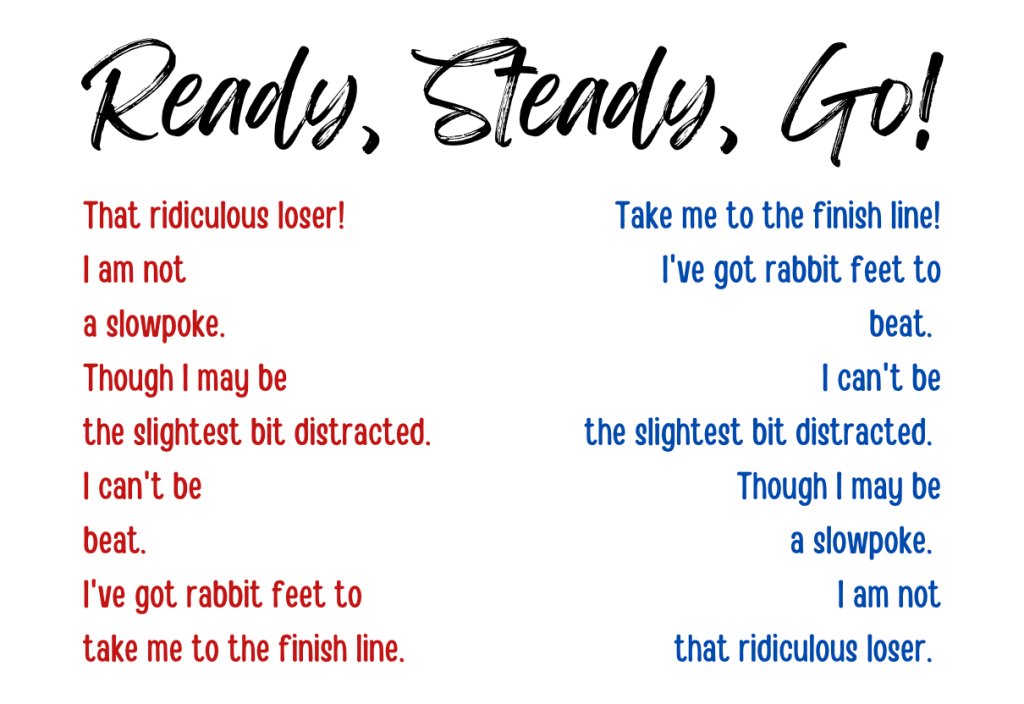
Excerpt:
Activity:
This book of poems is a perfect companion to any lesson on perspective. Use any page independently for a lesson. For example, the poem Ready, Steady, Go!, will give the points of view of the two characters in the much loved fable, The Tortoise and The Hare. Use the same formula to write a reverso poem for other fables like The Lion and The Mouse.
Have students partner up to read the pair of poems. Each student reads one of the paired poems emphasizing tone and inflection. Have the class reflect of how the same words can mean something completely different with a few changes.

